A traveller’s glossary of Braj
The words you will hear all day — darshan, aarti, jhanki, parikrama, prasadam, Radhe Radhe — explained so nothing sounds like a mystery. Learn a few and the circuit opens up immediately.
Start with these
The three words you will hear most
Darshan — the act of seeing and being seen by the deity; the entire purpose of a temple visit. Aarti — the ritual waving of lamps before the deity, with bells and incense, at set times each day. Radhe Radhe — the Braj greeting and farewell, used by everyone, everywhere, in place of namaste.
- Darshan / dar-shun /
- The auspicious sight of the deity — the point of visiting any temple. "Have darshan" means go in, see, and be seen.
- Aarti / aa-rti /
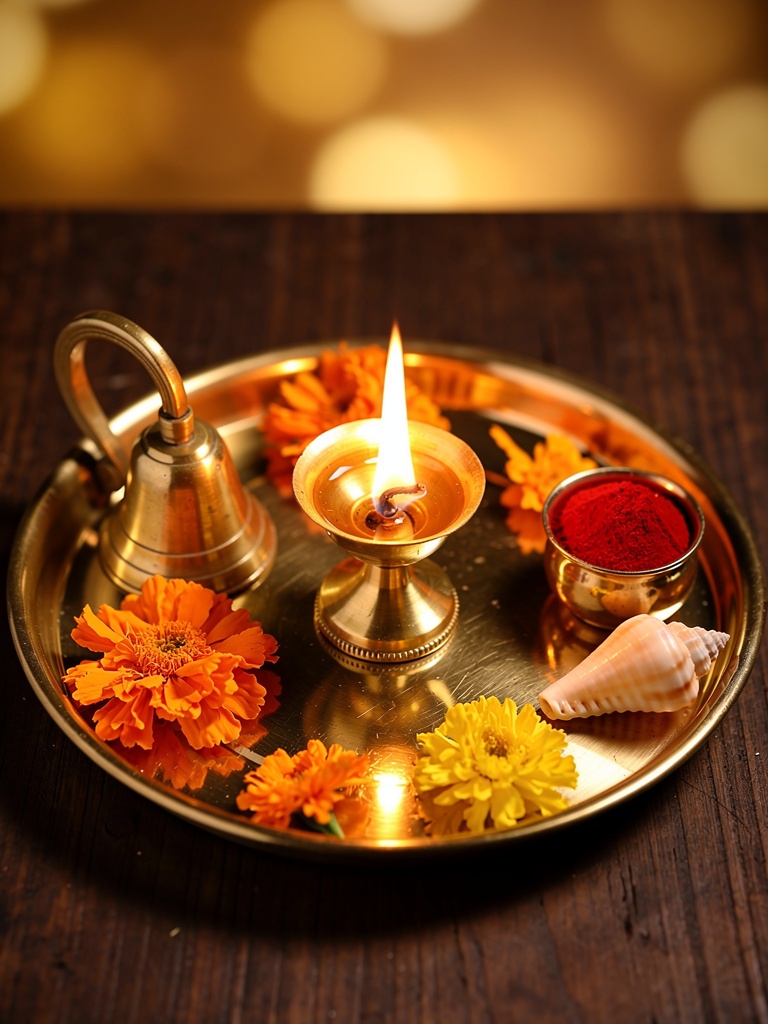
- Ceremonal lamp-waving before the deity with bells and incense; held at fixed times (mangala, sandhya, etc.). Visitors join, sing, and receive the lamp's flame to their hands.
- Jhanki / jhun-kee /
- A brief, curtained glimpse of the deity — the traditional darshan style at Banke Bihari. The curtain parts, devotees see, the curtain closes.
- Parikrama / pa-rik-ra-ma /
- Circumambulation — walking around a sacred object or hill. The Govardhan parikrama is the famous 21 km circuit of the hill.
- Prasadam / pra-sa-dam /
- Food (or any offering) blessed by the deity and distributed to devotees. Eat it fresh; take the wrappers with you.
- Ghat / ghat /
- A riverside stepped landing where pilgrims bathe or worship. Vishram Ghat is Mathura’s main one; the aarti there is the evening ritual.
- Kund / koond /
- A sacred water tank or stepwell — Radha Kund, Kusum Sarovar, Mansi Ganga. Ritual bathing points, not swimming pools.
- Shikhara / shi-kha-ra /
- The tall tapering tower over a temple sanctum — the skyline of every Braj town.
- Haveli / ha-ve-lee /
- A traditional mansion; in Braj, temples styled as royal residences (like Dwarkadhish) where the deity is dressed, fed and rested on a daily schedule.
- Garbh Griha / gurbh gree-ha /
- The innermost sanctum holding the deity — the most sacred, and often no-photo, part of a temple.
- Mangala / Sandhya / man-ga-la · san-dhya /
- The dawn and dusk aarti times — the two most atmospheric windows for darshan.
- Raas-lila / raas lee-la /
- The divine dance of Krishna with the gopis — the central pastime of Vrindavan, celebrated at Nidhivan and Prem Mandir.
- Gulal / goo-lahl /
- The coloured powder of Holi. It stains everything permanently — old clothes, goggles, sealed phones.
- Lathi / la-tee /
- A wooden stick — the playful weapon of Barsana’s Lathmar Holi.
- Poshak / po-shak /
- The tiny silk outfits for deity dolls — a uniquely Braj souvenir sold in the bazaars.
- Peda / pay-da /
- Mathura’s signature sweet — dense, milky, cardamom-scented. Buy fresh from a busy shop.
- Kos / kose /
- An old distance unit (~3.2 km). The 84-kos yatra is the ~270 km circuit of all Braj.
- Braj / Vraja / bruj /
- The sacred region of Krishna’s childhood — Mathura, Vrindavan, Gokul, Govardhan, Barsana, Nandgaon and the land between.