What "84 kos" actually is
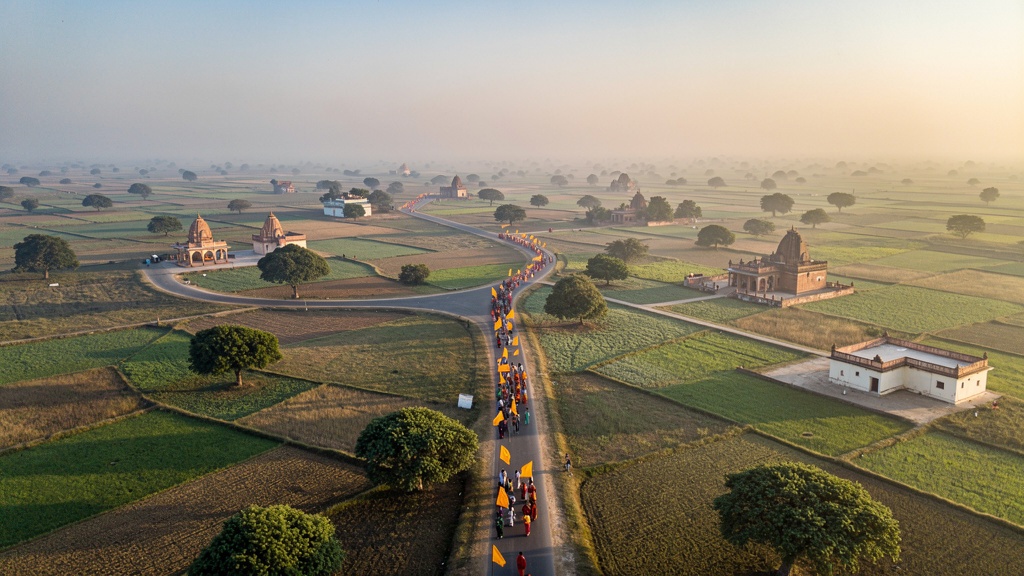
The yatra is a traditional circumambulation of the entire Braj region — a circle whose notional centre is the Govardhan hill and whose route strings together dozens of pilgrimage sites: Mathura, Vrindavan, Gokul, Jatipura (Govardhan’s base), Radha Kund, Barsana, Nandgaon, Baldeo and countless smaller kunds and groves. A kos is roughly 2 miles (~3.2 km), so 84 kos lands around 270 km as the route is walked.
Two honest truths: (1) the exact route has no single canonical map — tradition, guide-books and operators vary at the margins; (2) it is a serious physical and logistical undertaking on foot. Most modern pilgrims do it by vehicle over 5–8 days with daily halts and walk the key sections — that is how families and seniors complete it.
Core halts on the classic loop
| Area | What to see |
|---|---|
| Mathura | Janmabhoomi, Dwarkadhish, Vishram Ghat — the yatra’s anchor. |
| Vrindavan | Banke Bihari, Nidhivan, Prem Mandir, the Goswami temples. |
| Gokul / Raman Reti | Krishna’s childhood sand and ghats — essential for the "Braj kid" narrative. |
| Govardhan (Jatipura base) | Parikrama start, Kusum Sarovar, Mansi Ganga, the Annakut legend. |
| Radha Kund / Shyam Kund | The most sacred water in Braj; intensely silent after the crowds of Vrindavan. |
| Barsana | Radha Rani’s hilltop shrine; also the Lathmar Holi stage. |
| Nandgaon | Nanda’s village and Holi’s other end. |
| Baldeo (Dauji) | Balaram’s grand shrine — the deep-cut, rarely-toured reward. |
Foot vs vehicle — decide honestly
- On foot (12–20 days): the classical form. Needs trained legs (15–20 km/day), winter months, support arrangements for luggage and lodging, and real heat management. Groups and experienced pilgrims choose this; a first-timer solo attempt is unwise.
- Vehicle (5–8 days, the modern default): tempo, taxi or car with a driver who knows the circuit. Walk the parikrama sections and town cores; drive between regions. Ideal for families, seniors and international devotees with limited days.
- Weekend sampler: even 48 hours can cover the emotional spine — Govardhan parikrama by morning, Radha Kund at noon, Barsana at sunset. See the 3-day circuit as the scaffold and add a day.
Logistics that matter
- Seasons: Oct–Mar only. Kartik (Oct–Nov) is traditional and packed; Dec–Jan is cold but beautiful; post-Holi heat kills the yatra.
- Driver: fix a multi-day rate, halts and overnight stops in writing (or WhatsApp); drivers who "know the route" vary wildly. Ask your hotel for referrals, not the station tout.
- Lodging: Mathura (hotels), Vrindavan (ashrams/ISKCON guesthouse), Govardhan (dharamshalas near Jatipura) and Barsana (limited, rustic). Book festival windows months ahead.
- Money: cash is King in villages; ATMs cluster in Mathura/Vrindavan town. Keep UPI as backup, small notes for offerings.
- Mobile data: patchy between villages — download the parikrama guide and maps offline.
A realistic 6-day vehicle skeleton
- Day 1
Mathura
Janmabhoomi, Dwarkadhish, museum, Vishram Ghat aarti.
- Day 2
Vrindavan
Banke Bihari, Nidhivan, ISKCON, Prem Mandir night.
- Day 3
Gokul & Raman Reti
Morning childhood sites; afternoon drive toward Govardhan base.
- Day 4
Govardhan parikrama
Full 21 km by vehicle with all halts; Kusum Sarovar at dawn.
- Day 5
Radha Kund + Barsana hills
Morning kunds, afternoon Radha Rani temple; night near Nandgaon.
- Day 6
Nandgaon & Baldeo → home
Morning shrines, then the run back to Mathura/MTJ or Delhi.
Start with the 21-km Govardhan parikrama → · Or keep it short with the 2-day plan →