What "Braj" actually means
Braj (ब्रज, from Sanskrit vraja — a cow-pen or pasture) is the region of north-western Uttar Pradesh around Mathura, Vrindavan, Gokul and Govardhan, bounded informally by the Yamuna river and the rolling countryside east of it. In the Puranas it is the Braj-bhumi — the 84-kos (~270 km) circular land where Krishna spent his childhood and youth, where Radha lives, and where every hill, tank and grove carries a story.
For a traveller the practical boundary is simpler: the towns of Mathura, Vrindavan, Gokul, Govardhan, Barsana, Nandgaon and Baldeo, plus the hamlets and kunds between them. The official district portal (mathura.nic.in) frames the area exactly this way — not as a single pilgrimage town but as a circuit of living shrines.
Geography in one glance
Mathura sits on the right bank of the Yamuna at roughly 27.49°N, 77.67°E, about 145–170 km south of Delhi by road and 55–62 km north-west of Agra. The Yamuna divides the region: Vrindavan lies a short ~10 km north of Mathura on the far bank; Gokul and Raman Reti are around 15 km south-east on the other side of the river; Govardhan hill rises ~23 km west; Barsana and Nandgaon are hill villages on the ridge beyond.
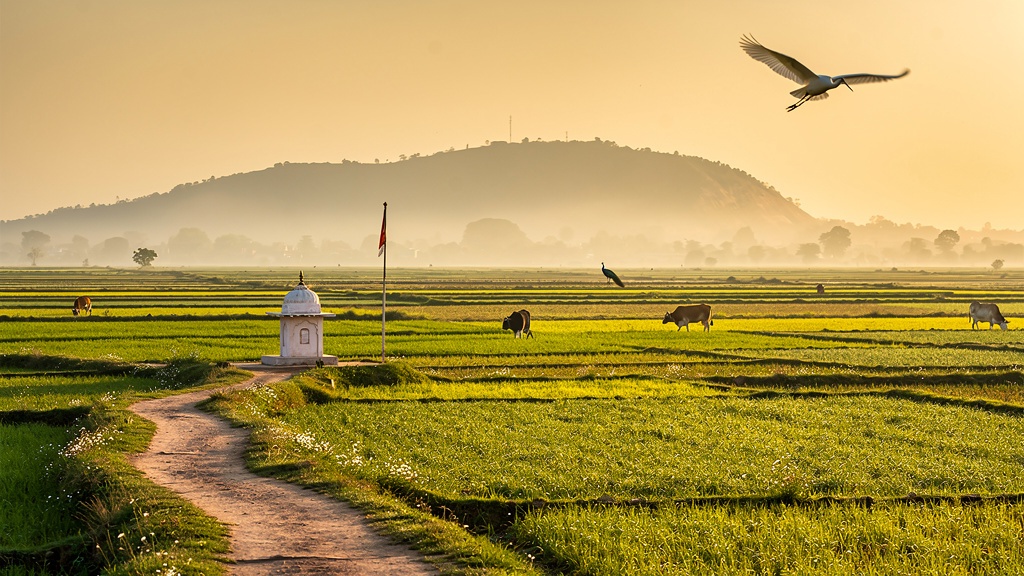
This is a flat, fertile riverine plain — good for walking, e-rickshaws and short hop taxi days, and hard only in the monsoon when the Yamuna swells and low-lying temple approaches flood.
Legend: Krishna’s Braj
In the Bhagavata Purana, Mathura is the fortified city of the Yadava king Kamsa, who hears a prophecy that his sister Devaki’s eighth child will kill him. It is from the dungeon of Katra — the site now called Krishna Janmabhoomi — that the newborn Krishna is smuggled across the swollen Yamuna to Gokul. He grows up among cowherds at Gokul and Raman Reti, fights the serpent Kaliya in the deep river bend, lifts Govardhan hill over the cowherds during Indra’s storm, dances with the gopis in Vrindavan, and is recalled to Mathura to slay Kamsa.
Every site in this guide is keyed to some moment of that story. Pilgrims come to walk where Krishna walked — and that is the primary purpose of the trip. Treat it as legend, not documented history, and you will enjoy it far more.
Devotees say Braj is not a place you visit but a person you meet. The same ground, studied in a museum, reads as one of the oldest and most sophisticated art-producing cities of the ancient world.
Archaeology: the Mathura school of sculpture
Independent of the Krishna story, the city itself is extraordinarily old. Epigraphic and archaeological evidence puts a thriving urban centre here by the 6th century BCE; the Mahābhārata and early Buddhist texts know it as a great city. Under the Kushans (1st–3rd century CE) and Guptas (4th–6th century CE), Mathura was one of three great sculpture-producing centres of India — with Gandhara and Amaravati — and for many scholars the most original.
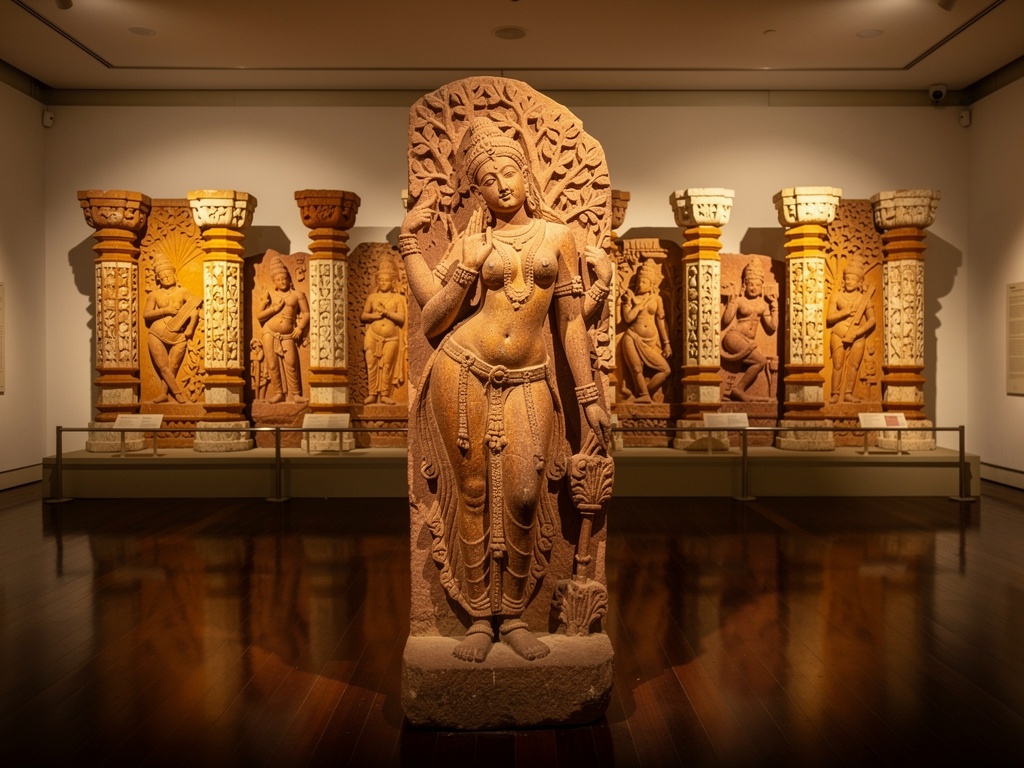
The Mathura school worked in the local red-spotted sandstone. Its artists created robust, warm, humanised images — yakshas and yakshis, Jains, Buddhists and Brahmanical deities side by side — and are credited with producing some of the very first anthropomorphic images of the Buddha, centuries before the Gandharan tradition’s Greco-Roman style became famous.
The finest surviving body of this work is at the Government Museum Mathura (est. 1874), the richest such collection in North India. If you have even a passing interest in history, the two hours it takes are the single best-value "non-temple" experience in the circuit.